

The path I’m still blazing.
If you found this page, you probably already know a little about me. Maybe you’ve taken a class, watched a video, or someone just mentioned UChapter2 in passing. This is the rest of it: how I actually got here, five jobs and one hard season at a time.
The Business I Built On the Side
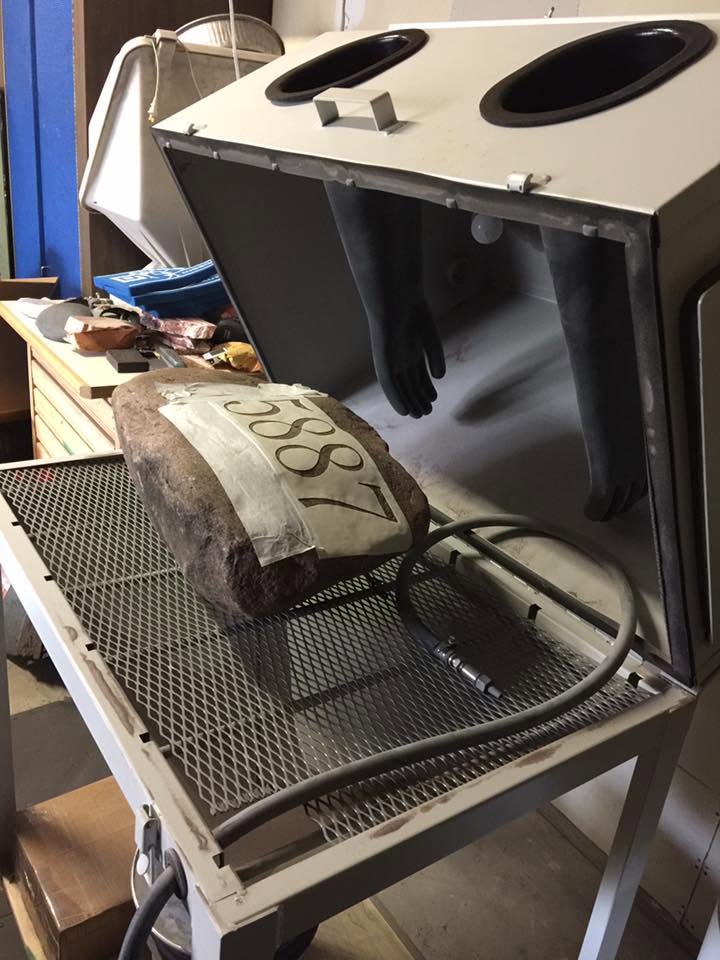
In 2011, my wife Theresa was in an accident that left her with a brain injury. It ended her nursing career and cut our household income roughly in half. Around the same time, both of our sons were diagnosed with autism. I picked up a second and third job to keep things afloat, and somewhere in that stretch, I started a custom stone and glass engraving business on the side.
It became more than a way to make extra money. It became proof, to myself, that I could still build something good even when everything else felt like it was falling apart.
Every piece I made was custom. I never sold anything off a shelf. I’d meet with a client, learn their style, and design around it, sometimes choosing a stone specifically because a crack, a flat spot, or a shade of color matched what we were engraving on it. One design, a set of wine glasses etched with fill lines for “easy day,” “rough day,” and “don’t ask,” ended up selling several hundred units. Nine of them shipped to a customer in Arizona who found the glasses on Facebook.


I only upgraded equipment with cash the business had already earned. Never borrowed. That’s a discipline I still hold at UChapter2 today. And when the business had grown enough that I could have scaled it into something full-time, I chose not to. I didn’t want to spend my life standing in front of a sandblaster.
Here’s the thing that stuck with me: a tool built for everyone is built for no one. I never sold a generic engraved rock off a shelf, and years later, UChapter2 doesn’t sell generic Bluebeam tools built to sort of work for every trade. We build for the customer in front of us. Same idea, just a different product.
Five Jobs, One Thread
My path to UChapter2 was never paved. It runs through five jobs, nearly two decades of structural design if you add it all up. Each one taught me something that’s still built into how UChapter2 operates.
It started with a high school internship at a structural steel detailing company, where I spent about four years. I learned to hand-letter like thirteen different senior drafters so my edits would match their originals, and I eventually helped lead the company’s shift from manual board drafting to AutoCAD. That was my first real lesson in change management, and in how much a tenured expert knows that never makes it onto paper.
From there, I spent fourteen years at a large multi-office engineering firm, where I helped lead roughly seventy employees across seven offices through the shift from CAD to Revit and BIM. Before we started, I had to write a business implementation plan just to get the project approved. The full implementation included Structural, Mechanical, Electrical, Plumbing, Fire Protection, Civil, and Laser Scanning. That’s where I figured out my real strength wasn’t being the guy with every technical answer. It was being a relational people manager, someone who could point you to the answer or find it with you. I’d earned that role through nearly a decade and a half of reputation built inside one company, and for a long time, the thought of starting over and building that kind of trust again somewhere new felt like too much of a risk to take.
Next came about two and a half years at an industry-leading, Revit-focused design firm. This is where the accident and the diagnoses landed in the timeline. I was working three jobs by then, and I’ll say it plainly: I was distracted, and I was underperforming. I’m not proud of that stretch of work. I am proud of what came after it.
After that, I spent a year at a firm that advertised itself as a BIM shop but modeled more like glorified CAD, working alongside a team of ten on a high-profile stadium project. I’d been hired for my experience, and I assumed that meant they wanted to hear it. Instead, it was treated like a normal part of the job to work a handful of thirty-six-hour shifts, and my ideas for improving how the team worked got buried under a heavier workload instead of a conversation. I learned there that experience only helps if someone’s willing to hear it. That’s what burned me out completely. I reached a point where I didn’t want to design anything, ever again.
That’s when I pivoted into a software reseller, one that sold Autodesk and Bluebeam, which was later acquired and became the largest reseller of its kind. I’d realized I had a new passion, not for design anymore, but for building people and processes. I started on the help desk and moved into implementation work. There was no real Bluebeam training out there at the time, so I taught myself, and I started documenting what I learned through a content brand I called Bluebeam and Burgers. When that reseller merged with a larger one, the new leadership didn’t initially see the value in Bluebeam services and training and told me to find a different focus. They had me write a business plan to justify keeping the role, so I did, and they let me run with it. I helped grow that division into a real piece of the business, and the president later introduced me to a major customer as one of the top three Bluebeam trainers in the world. My boss saw it differently: to him, my skills were a tool of his success, not a team success.
Looking back, every one of those jobs was really the same skill in a different room: a custom implementation. I learned what leadership actually looks for, what users actually need, and that training itself is the cheap part, it’s pulling people off their projects that costs real money, though nothing costs more in the long run than skipping training altogether. I led a team of 13 at that first engineering firm and a team of 70 at the second, and in between I picked up pieces I didn’t expect: writing marketing copy, learning to work with a web design professional instead of guessing at it myself, running demos, selling services. Underneath all of it was the same skill: learning how to listen. By the time I launched UChapter2, I’d already had a hand in every part of running a business. I just hadn’t put a name on it yet.
I couldn’t test any of it on the side first. Building UChapter2 while I was still working for a company would have been unethical, and that wasn’t a line I was willing to cross. So I spent the next fourteen months building my own network, on my own time, with no safety net and no practice run. Then I burned the ships and launched UChapter2.
I’ve come to believe you can trust your struggles. Every hard stretch I just told you about taught me something I needed, and it took me somewhere better than I would have planned for myself.
Where That Leaves Us Today
Both halves of this story point at the same thing. The engraving business taught me that a tool built for everyone helps no one in particular. The five jobs taught me that the most useful person in the room isn’t always the one with the answer. It’s the one who can get you to it.
That’s the whole idea behind UChapter2. I built all of it, and I still show up for every bit of it myself. I stand behind the courses, the tools, and the systems, because I’m the one who built them. The work never stops teaching me something new, so I never stop getting better at it either.
I don’t know exactly where this road goes next. I didn’t know it would lead here either. I just know I’m still on it.
If any of this sounds like your own story, in construction or otherwise, I’d love for you to stick around. Now that you know a bit about how I got here, take a look at what UC2 actually does.
Troy DeGroot, Founder of UChapter2