

Where the Work Is in 2026

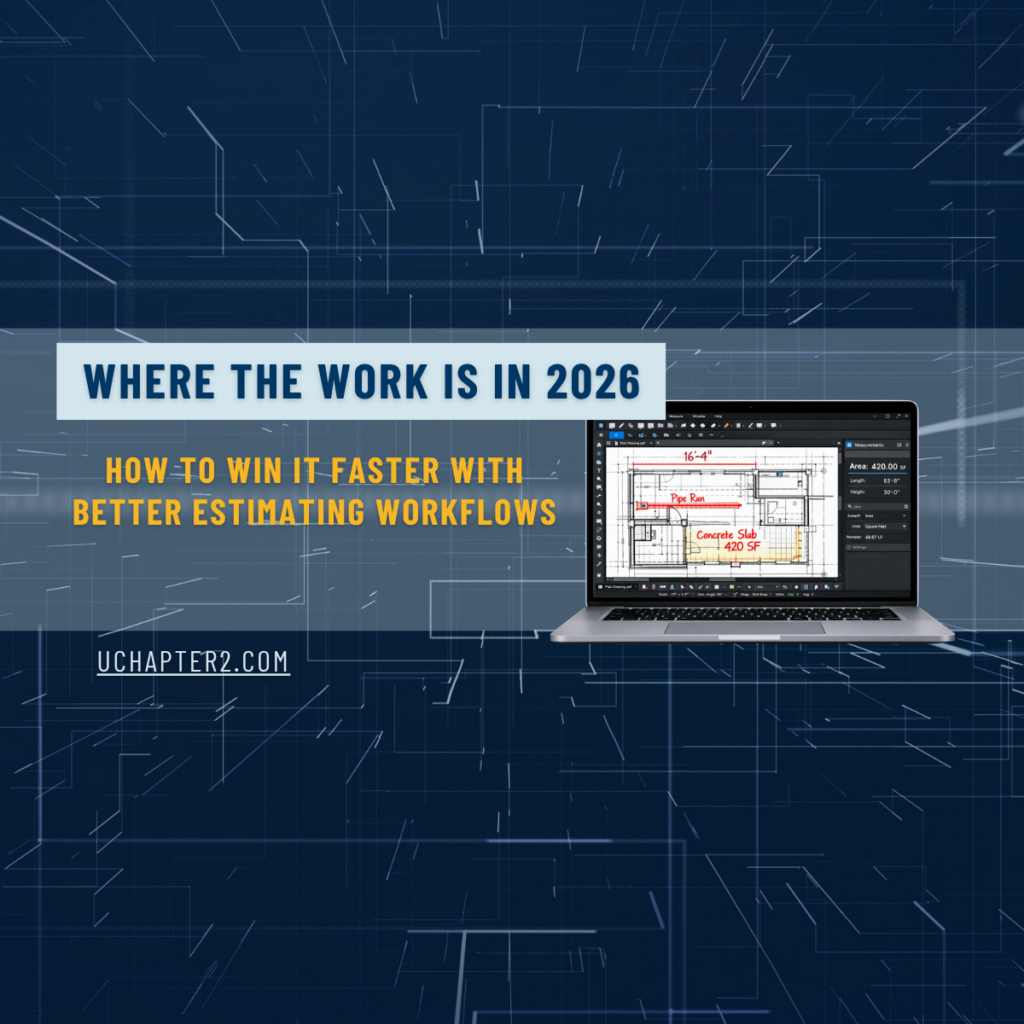
How to Win It Faster with Better Estimating Workflows
If you’ve been paying attention to the construction industry lately, you’ve probably noticed the same thing I have. The work is out there, and in many cases, there’s more of it than teams can comfortably handle.
Data centers are expanding at a rapid pace, driven by demand for AI and cloud infrastructure. At the same time, infrastructure projects continue to gain momentum through both public and private investment. These aren’t small jobs. They’re complex, fast-moving, and often come with high expectations around speed and accuracy.
On the surface, that sounds like a great problem to have. More opportunity usually feels like progress. But more work doesn’t automatically lead to better results.
What I’ve seen, working with contractors across different trades, is that the real challenge right now isn’t finding work. It’s delivering that work efficiently while protecting your margins. As project volume increases, so does the pressure on estimating teams. Timelines tighten, drawing sets grow, and revisions happen more frequently. Without a solid workflow in place, teams start reacting instead of operating with intention, and that’s where small inefficiencies begin to stack up.
An estimate that takes a little too long, a scope gap that gets missed, or a revision that doesn’t get fully accounted for may not seem like major issues on their own. But across multiple projects, they start to impact profitability in a real way.
Estimators Aren’t Just Estimating, They’re Collecting Data
One of the biggest mindset shifts I try to help teams make is this, estimators aren’t just building numbers, they’re collecting data. They’re digging into drawings and specifications, pulling out the fine details that define the project. They’re identifying scope, understanding intent, and uncovering the information that ultimately determines whether a job is successful or not.

That work has real value, but in a lot of companies, it gets trapped. It lives in someone’s head or maybe in a spreadsheet, and then the next person in line has to go figure it all out again. In some cases, they miss something that was already discovered. That’s where gaps start to form, and those gaps don’t show up immediately. They show up later during ordering, installation, or closeout, when it’s much more expensive to fix.
The Handoff Is Where Most Teams Lose Efficiency
What I look for in every company I work with is how well they pass the baton. Estimating should not be the end of the process. It should be the beginning of a connected workflow that carries information forward.
When that doesn’t happen, teams naturally fall into silos. Estimating does their job, project management rebuilds information, field teams reinterpret drawings, and closeout becomes a scramble. Everyone is working hard, but they’re not working from the same source of truth. That disconnect is where efficiency is lost.
Markups Should Carry the Project, Not Just the Estimate
This is where I see a lot of untapped potential. The same markups used for takeoffs can do much more than calculate quantities. When they’re built intentionally, they can carry information forward through the entire project lifecycle, from estimating to material ordering, project planning, installation, and even as-builts.

Instead of starting over at each phase, teams can build on what’s already been done. That reduces duplicate effort, improves communication, and creates consistency across the entire project. It doesn’t require new software. It requires a better approach to how you use what you already have, like Bluebeam Revu.
The companies that succeed in construction over the next five years will be the ones who treat estimating as a data-driven process, not just a bidding task.
What This Looks Like in Practice
Having built custom estimating tools for just about every CSI division, I’ve seen this approach work across multiple trades, not just concrete. In one example, I worked with a contractor who shifted their process so information was captured once and used throughout the project. You can see a breakdown of that approach here, Tilt-Up Contractor Using Bluebeam Revu to Save Time.
In another article, 5 Ways Concrete Contractors Get the Most Out of Bluebeam Revu, I walk through simple ways to structure markups so they do more than just measure; they actually support the workflow.
I’ve also had the opportunity to contribute to the Bluebeam Blog, where the same pattern shows up across different types of contractors. Whether it’s How Concrete Contractors Can Best Use Bluebeam Revu or How Tilt-Up Concrete Contractors Can Best Use Bluebeam, the common thread is consistent. The teams seeing the biggest gains are the ones who are thinking beyond their own role and building workflows that support the entire project.
Where AI Fits Into All of This
Right now, everyone is talking about AI. Some are excited, some are unsure where it fits, and most teams don’t know where to start.
The way I look at it is simple. AI is only as good as the data you give it, and in construction, that data comes from your projects. If your workflows are inconsistent, your data will be inconsistent. If your data is inconsistent, AI doesn’t have much to work with.
But when your workflows are structured, your markups are consistent, and your estimating process is capturing real, usable information, you start building something valuable. You’re building historical data.
That’s what will power AI in our industry.
So if you’re wondering where to start with AI, it’s not with a new tool. It’s with your current workflow. Start by standardizing how you capture information, creating consistency across your team, and making sure your data can be reused instead of recreated. That’s how you prepare, not by chasing AI, but by getting your workflows ready for it.
Looking Ahead to 2026
The opportunity in construction isn’t slowing down. Data centers, infrastructure, and large-scale projects will continue to drive demand. But the companies that benefit the most won’t just be the ones who win the work. They’ll be the ones who can deliver it with consistency, accuracy, and control.
That starts with recognizing the role your estimators are already playing. They’re not just building numbers; they’re building the data your company runs on. The real opportunity is making sure that data doesn’t stop at bid day. When it flows through your entire project and becomes part of your historical data, you’re not just improving today’s results; you’re building a foundation for what comes next.
Because the companies that are ready for what’s coming aren’t waiting on AI to figure it out. They’re getting their workflows in order now, so when AI technology becomes unavoidable, they’re ready to use it.
If you’re looking at your current workflows and wondering where the gaps are, that’s usually the best place to start. Small changes in how your team captures and shares information can have a bigger impact than most people expect.
Common questions:
Why is the estimating-to-project-management handoff where most teams lose efficiency?
When estimating data doesn’t get passed forward, every team downstream has to rediscover what was already found. Everyone works hard but not from the same source of truth. That disconnect is where efficiency disappears.
Can estimating markups do more than support a bid?
When built intentionally, the same markups used for takeoff can carry information forward into material ordering, project planning, installation, and as-builts, reducing duplicate effort at every phase.
What does preparing for AI in construction actually look like?
It starts with your current workflow, not a new tool. If your data is inconsistent, AI doesn’t have much to work with. Teams getting ready are standardizing how they capture information now, so historical project data becomes something worth learning from.
Looking for a Bluebeam community centered around Bluebeam workflows and real-world construction experience? You’re always welcome to join the conversation in the Bluebeam Brainery.
Are you looking to learn from other industry experts? We have several live webinars coming up. Get Registered on the UChapter2 Events Page.
Interested in learning more about UChapter2 training and services? Contact Us.

Responses