

You Don’t Need More People, You Need Better Workflows

How construction workflows and Bluebeam help teams overcome the labor shortage
The Labor Shortage Is Real, But So Is the Opportunity
The labor shortage in construction has become part of the daily conversation. Crews are stretched, timelines are tight, and most companies are being asked to deliver more with fewer people.
The typical response is to focus on hiring. How do we find more workers? How do we keep them? How do we stay competitive in a shrinking labor pool?
Those are fair questions. But there’s another one that often gets overlooked, and in many cases, it has a more immediate impact.
How is the work actually getting done?
Where Time Disappears in Everyday Workflows
Small Inefficiencies Add Up Fast
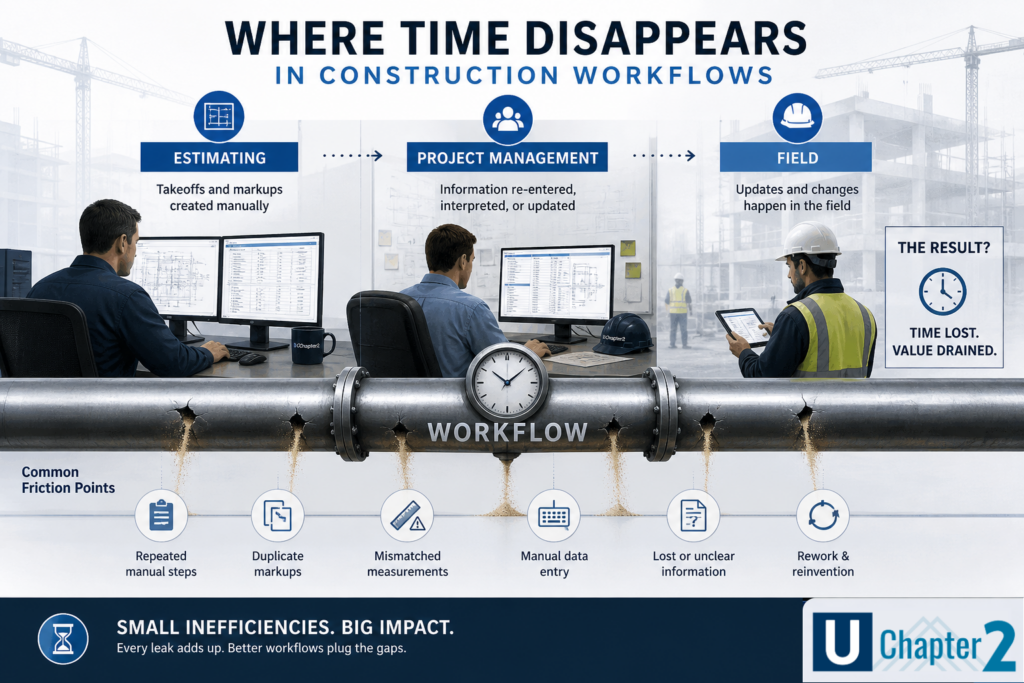
When you take a closer look inside most construction teams, the issue usually isn’t effort. People are working hard. What tends to surface instead is friction, the kind that builds quietly over time.
It shows up in small ways. Repetitive manual steps that feel unavoidable. Slight differences in how team members approach the same task. Information that doesn’t quite carry cleanly from estimating to project management to the field.
None of these are major problems on their own. But together, they create a steady drag on productivity. This is where time disappears, not in big, obvious losses, but in small inefficiencies that compound across every project.
Why Adding People Doesn’t Always Solve the Problem
More Hands, Same Process
It’s natural to assume that adding more people will relieve the pressure. Sometimes it does. But if the underlying workflow stays the same, those new team members are stepping into an environment that still carries the same inefficiencies.
They learn inconsistent processes. They repeat the same manual steps. In some cases, the complexity increases as more people are added, creating even more variation in how work gets done.
Instead of solving the problem, the organization ends up scaling the friction.
A Shift in Thinking That Changes Everything
Instead of asking,
“How do we find more people?”
Start asking,
“How do we help the people we already have work more effectively?”
That shift is where meaningful change begins, and it’s where better workflows start to make a measurable difference.
Using Bluebeam More Intentionally
This is where tools like Bluebeam Revu begin to show their real value, not as a list of features, but as part of a connected workflow.
Most teams are already using Bluebeam in some capacity. The opportunity isn’t adoption. It’s using it more intentionally.
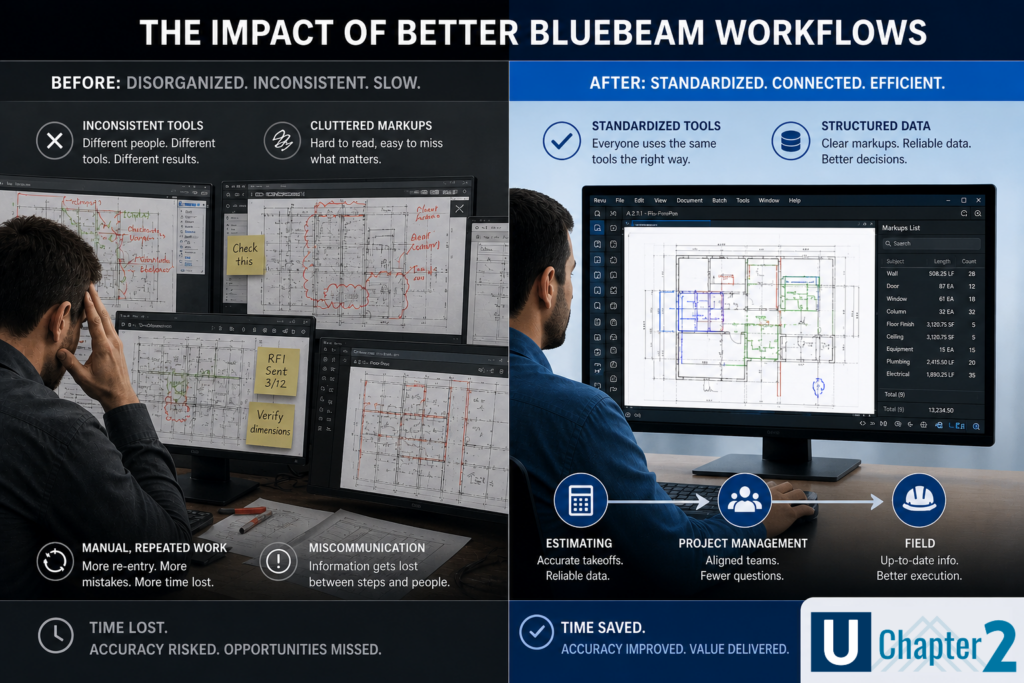
When that happens, even small adjustments can create meaningful change. A standardized approach to tool sets brings consistency across the team. Markups begin to carry data, not just visual notes. Information flows more naturally from one phase of a project to the next, instead of being recreated or interpreted along the way.
These aren’t dramatic overhauls. They’re refinements. But those refinements reduce manual effort, improve accuracy, and remove unnecessary steps from everyday work.
What It Looks Like When Workflows Improve
A Real-World Example
This isn’t theoretical.
In a Bluebeam case study featuring Musselman & Hall Contractors LLC, the estimating team was able to save approximately 60 hours per month by improving how they used Bluebeam for takeoffs.
That time wasn’t created by adding staff. It came from:
- More efficient takeoff workflows
- Better use of markup data
- Stronger alignment between estimating and project management
The impact extended beyond estimating. Collaboration improved across departments, and the company began to see more consistent, predictable results across projects.
Their clients even described them as “next level”, not because they were working harder, but because their processes were more refined.
Why Data Still Matters, Even If You Don’t See It Yet
If you’ve followed along with some of my recent content, you’ve seen the idea that estimators are really data collectors. That concept plays directly into this conversation.
When workflows are consistent, the information captured during takeoffs doesn’t just serve the estimate. It carries forward into project management, the field, and even future projects.
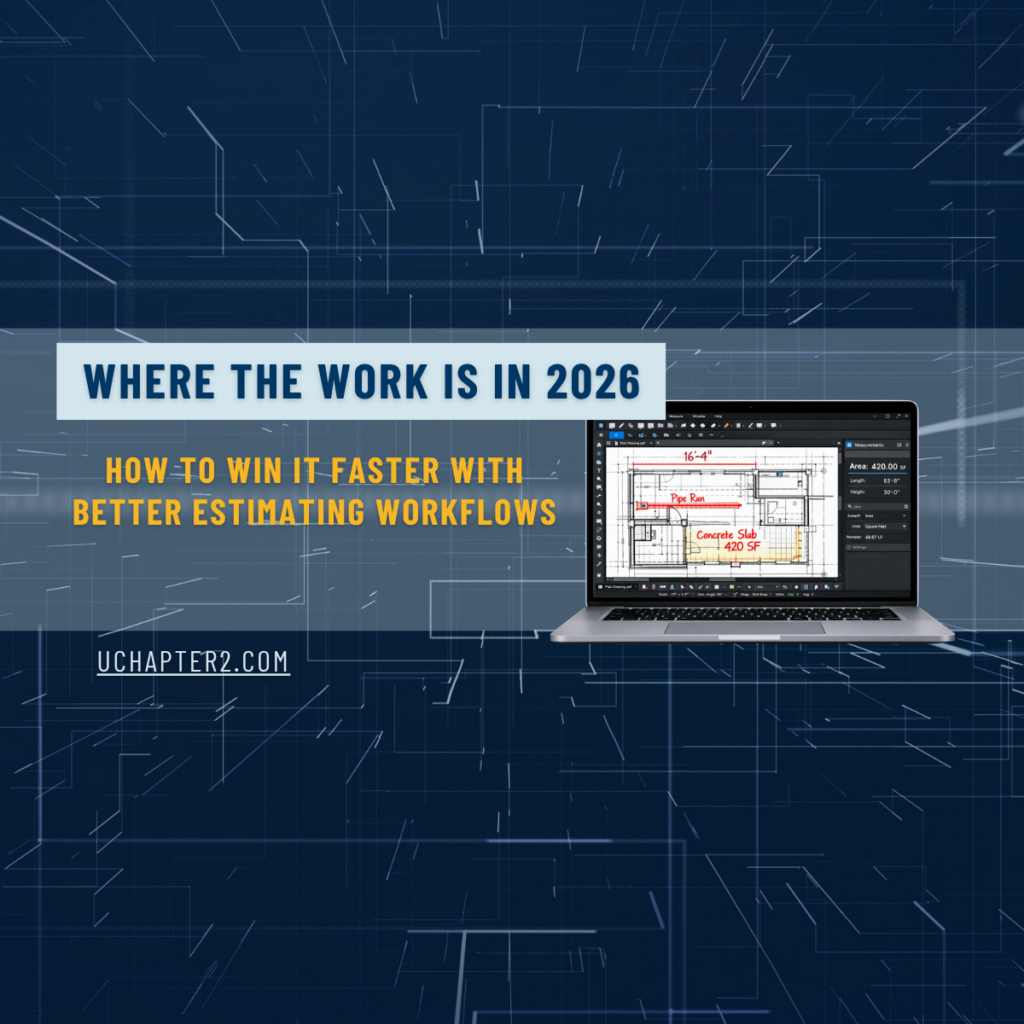
If you want a deeper look at that idea and how it connects to long-term efficiency and AI readiness, check out my previous blog, “Where the Work is In 2026,How to Win It Faster with Better Estimating Workflows.”
Better workflows don’t just save time today, they create value beyond the task at hand.
Closing the Gap Between “Getting By” and Working Efficiently
Why Training and Customization Matter
A lot of Bluebeam users are self-taught. They know enough to get through their tasks, which makes sense in a fast-paced environment. But it also means there are often gaps in how the tool is being used. Not because the team isn’t capable, but because no one has had the time or structure to connect everything together. That’s where targeted training and customization come in. Not long, generic sessions, but focused efforts that align with how a company actually works. The goal is to simplify, remove unnecessary complexity, and build workflows that are repeatable and reliable. When that happens, teams don’t just work faster. They work with more confidence and consistency.
The construction labor shortage isn’t something most companies can control. But how the work gets done is. Better workflows don’t replace people. They support them. They reduce frustration, improve consistency, and help teams focus on the work that actually matters. And in an environment where every hour counts, that can make all the difference.
If your team is feeling stretched, it may not be a staffing issue. It may be a workflow opportunity. A closer look at how your team is using Bluebeam can quickly reveal where small, targeted changes could lead to measurable gains in productivity, accuracy, and efficiency. As a Customer Success Manager, I’ve been a guide to many companies through personalized software implementations. It all starts by learning how your business works to find the hidden gaps. If you’re curious what this would mean for you, schedule a free introduction call with me.
Consistent Questions Leading to This Blog Post:
1. Why doesn’t hiring more people always fix productivity issues in construction?
Because inefficient workflows scale with the team. If processes are inconsistent or manual, adding people often increases complexity, not efficiency.
2. How can Bluebeam improve workflows without changing how our team works?
By standardizing how your team uses it. Simple changes, like consistent toolsets and structured markups, can reduce rework and improve flow between teams.
3. What are the biggest signs our workflows need improvement?
Look for:
-
Someone saying, “I only use Bluebeam to look at PDF’s.”
-
Repeated manual steps
-
Inconsistent processes between team members
-
Information getting lost between estimating, PMs, and the field
Looking for a Bluebeam community centered around Bluebeam workflows and real-world construction experience? You’re always welcome to join the conversation in the Bluebeam Brainery.
Are you looking to learn from other industry experts? We have several live webinars coming up. Get Registered on the UChapter2 Events Page.
Interested in learning more about UChapter2 training and services? Contact Us.

Responses