How Fast Can Your Team Actually Adopt Bluebeam?


There’s a question that comes up in almost every conversation before a company commits to Bluebeam training or implementation work. They rarely say it out loud, but it’s there.
“Is this actually going to stick?”
It’s a fair question. Plenty of companies have paid for training that didn’t stick. They’ve sat through a full day of features, gone back to their desks, and returned to doing things the old way inside of a week.
The question isn’t whether your team can learn Bluebeam. The question is whether the training is built in a way that makes what they learned translate into how they actually work.
Why Most Bluebeam Adoption Fails
Generic Bluebeam training teaches people the picks and clicks. It doesn’t teach them WHY to pick the clicks.
The problem is that most of what gets covered in a generic training session never connects to the actual work the student goes back to the next morning. The features make sense in the classroom. They feel disconnected at the desk.
So the student reverts. Not because they didn’t want to change, but because the connection between “what I learned” and “how I work” was never made.

The Two Types of Adoption
There’s a useful distinction between knowing how to use Bluebeam and knowing how to work in Bluebeam.
Knowing how to use it means you understand the features. You can find the tools, you know what they do, and you can follow a walkthrough.
Knowing how to work in it means Bluebeam is built into your actual daily process. You open it, the tools are set up for your workflow, and you move through your work faster because the software is working with you.
The second type of adoption is the goal. And it only happens when training is built around your actual workflow, not a generic curriculum.
What Fast Adoption Actually Looks Like
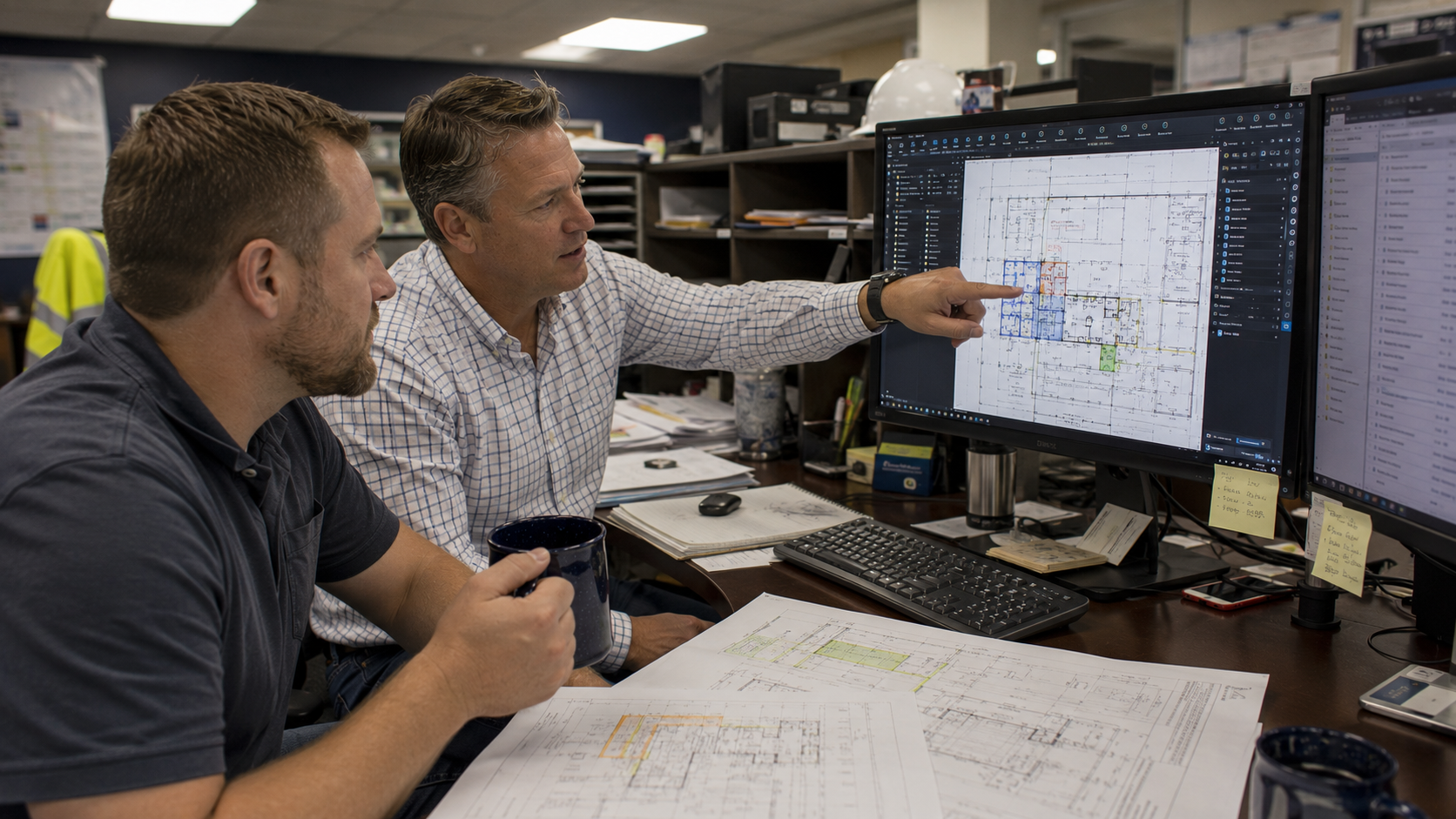
Troy DeGroot has been building and teaching Bluebeam workflows since 2017, before “workflow” became the word everyone in the industry started using. In that time, the clearest indicator of fast adoption has always been the same: how close is the training to the actual work?
When training sessions are built around specific workflows, students use what they learned the same day. Not weeks later after reviewing their notes. That day.
A real example: after a full implementation across two offices, Musselman & Hall’s preconstruction team was saving 3 to 4 hours a week per estimator, on every bid, a total of about 60 hours a month. Not a one-time spike. Every week, every bid, for months. The switch also let them retire several licenses of On-Screen Takeoff software they no longer needed. A single seat of that software typically runs $1,000 to $1,850 a year, so multiply that across every license removed and the software savings alone were significant, on top of the time back. That’s not exceptional. That’s what happens when training is built around the actual work instead of around the software.
What Determines How Fast Your Team Adopts
A few factors affect adoption speed more than anything else.
How specific is the training to your workflow? Generic training requires students to translate what they learned into their own context. Workflow-specific training eliminates that translation step.
Is the Bluebeam environment set up to support the new workflow? If your tools aren’t configured to match what was trained, adoption fights friction from the start. A well-built environment makes the new workflow the path of least resistance.
Does the team have a clear standard to follow? When everyone knows what “right” looks like in Bluebeam, they can hold each other accountable. Without a standard, individuals revert independently.
Try This: Turn Any Markup Into a Reusable Tool
If you take one thing from this post, make it this. One of the fastest ways to speed up adoption is to stop rebuilding the same markup every time, and it works the same whether it’s a revision cloud, a stamp, or a takeoff measurement. Here’s how to save one in Revu 21.
- Select the markup and open the Properties Panel (Alt+P).
- Style a markup exactly how you want it: color, line width, font, and Subject.
- Right-click the markup and choose Add to Tool Chest.
- Pick the Tool Set where it should live, or start with My Tools.
- Next time, open the Tool Chest (Alt+X) and click the tool instead of drawing it from scratch.
Every tool you save is one less thing a new user has to figure out on their own. That’s how adoption picks up speed.
Once you’ve built a few, put them in everyone’s hands. Here’s how to share a Tool Set with your team.
How UC2 Approaches Implementation
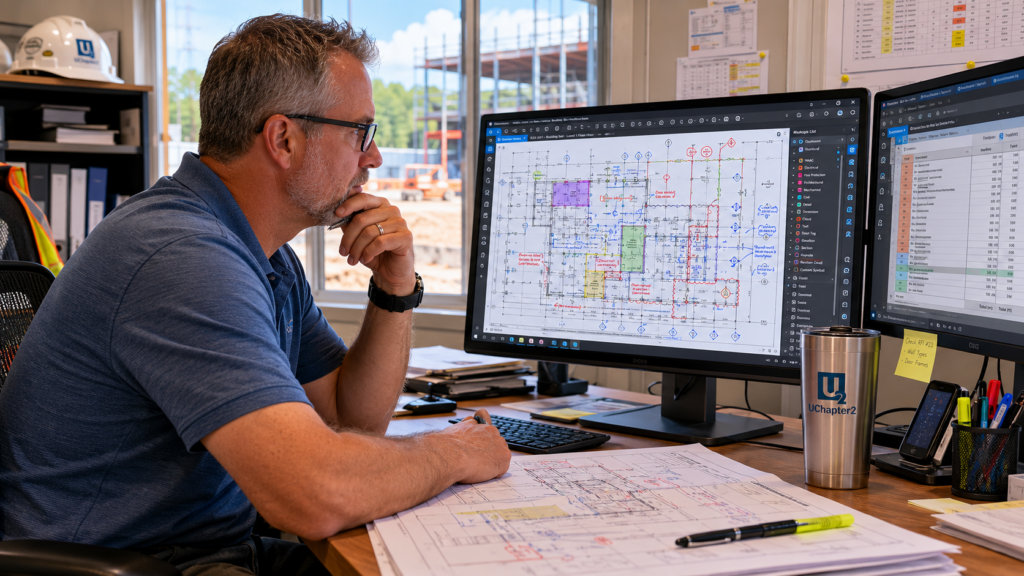
UC2’s training sessions are built around your workflow, not a syllabus. That means the starting point is understanding how your team works and where Bluebeam fits into that process.
From there, the training is designed around those specific workflows. Your tools, your document types, your measurement needs, your team’s actual daily process.
The result is that what gets learned in the session has a direct home in the work waiting back at the desk. That’s what makes it stick.
See how UC2 approaches Bluebeam implementation.
Frequently Asked Questions
How long before we see real results after implementation?
For workflow-specific training, the goal is results that don’t fade. Musselman & Hall’s preconstruction team, for example, has been saving 3 to 4 hours a week per estimator, on every bid, about 60 hours a month, since their implementation across two offices. It’s a big enough result that Bluebeam featured it as their own case study. Results vary by workflow complexity and team readiness, but consistent, lasting impact is common when training is built around the actual work.
What if some team members resist the new workflow?
Resistance usually has one of two sources: the workflow doesn’t actually fit how they work, or the tools aren’t set up to make the new approach easier than the old one. When both of those are addressed, resistance drops significantly. The goal is always to make it easier to do it the new way than to revert.
Is one session enough, or do we need ongoing training?
It depends on the scope of the workflow and the size of the team. A focused single session can produce immediate, lasting results for a specific workflow. More complex implementations or larger teams often benefit from a follow-up session after the team has had time to work with the new setup.
How do we know when adoption is actually working?
The clearest indicators are speed, consistency, and reversion rate. Is the team moving faster through the work? Do the outputs look the same across team members? Are people going back to old habits? When speed and consistency are up and reversion is down, adoption is working.

Responses